Content
- Memory and Learning
- The storage(Retain information)
- How forgetting could occur
- Memories strategies(How to improve your memory)
- Strategies for improving concentration
- Reading/Study system (SQ3R)
MEMORY AND LEARNING
LEARNING PYRAMID:-

Student need to understand how information is learned and understand uses of various kind of active learning strategies in learning, retaining and using the information (encoding, storage, and retrieval) and indicates how ONE learn, remember and forget.
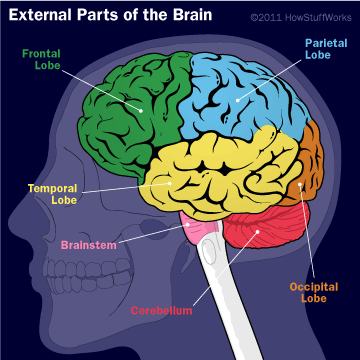
What is memory?
- Memory is the retention of information like brain store place where we remember something
What is brain?
- Brain is an organ of soft nervous tissue contained in the skull of vertebrates.
Part of computer component and part of human
Encoding/Input:-
- Computer:-
- Keybord, camera
- Human:-
- Five senses: ears, mouth, skin, nose, eyes
Storage:-
- Computer:-
- Hard disk, thumb drive
- Human:-
- 3 types of memory: sensory memory(SM), Short-Term-Memory(STM), Long-Term-Memory(LTM)
Retrieval/Output:-
- Computer:-
- Computer screen, printer, speaker
- Human:-
- Writing, walking, talking
STORAGE
Sensory Memory (SM)
- Numerous incoming information from 5 senses will be stored in the sensory memory for an instant
- If one “pay attention” to stimuli, it will go to the short-term-memory (STM)
- If one does not pay attention, then the information will be lost
- Therefore, it is very important to pay attention while lecture, reading and when doing something
Short-Term-Memory(STM)
- Have very limited storage.
- From SM information will be take over by STM
- While in the STM, information must be repeated or use some learning strategies in order to get information to LTM, others will be forgotten
- Therefore students must realize that applying memory strategies is important to strengthen the memory ability
Long-Term-Memory(LTM)
- This memory has unlimited and largest storage
- Information from STM will moved to LTM and stored there for later use(retrieval)
HOW FORGETTING COULD OCCUR
- Did not pay attention to the information
- Last minute study
- Interference( two exams in a day)
- Did not understand the information
- Did not have good strategies
- Negative thinking
MEMORY STRATEGIES
Memory strategies will help students to encoding, storing, and retrieving in order to make the students remember and recall information easier

Memory strategies (How to improve your memory):-
- Massed practice versus Space practice:
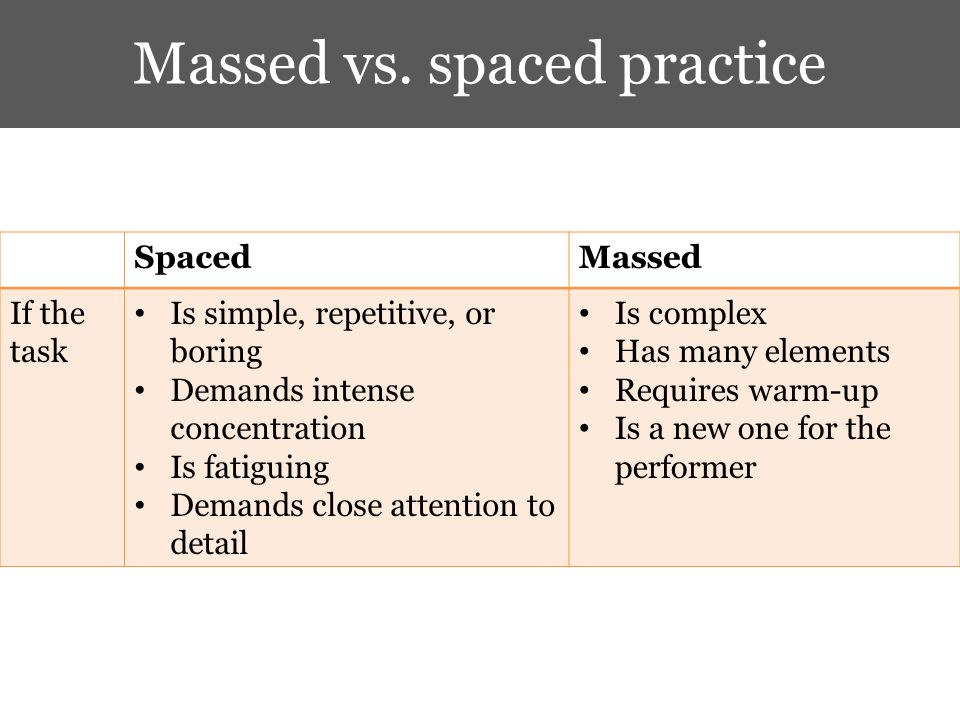
2. Have a break time after reading for some period, e.g. 2 chapters a day and not all chapters a day before exam.
3. Rehearsal/Repeat the information again and again, e.g. repeat a large amount of number 10 times
4. Elaboration strategies:
- Associations
- Connect each word with a person, place, things, feelings or situations.
2. Acronyms
- e.g. UiTM- Universiti Teknologi MARA
- e.g. PTAR- Perpustakaan Tunku Abdul Razak
3. Acrostics
- e.g. Carnivores- animal eaters
- e.g. Herbivores- plant eaters
5. Imaginary – Visualize the image of information needed
6. Organizational strategies – Organize the materials for example computer are divide into three part which are input, output, storage.
7. Comprehension monitoring strategies – Must comprehend the materials being read. SQ3R will be the best strategies
STRATEGIES FOR IMPROVING CONCENTRATION
Concentration:-
Focusing your attention on what you are doing.
Causes of poor concentration:
- Lack of attention
- Uncomfortable situation
- Distraction by others
- Lack of motivation
- Lack of interest
- Illness
- Anxieties
Strategies to improve concentration:
- Use motivational and organizational strategies
- Create a positive learning environment
- Deal with internal distractions
- Use active learning strategies
- Use your learning style in the task given
- Control your concentration
READING/STUDY SYSTEM (SQ3R)
- Create awareness by using a study system can help in comprehending reading academic materials due to three factors:
- Active learning strategies
- Use of multisensory methods(refer to learning pyramid)
- Immerse steps for self-testing and review
SQ3R
SQ3R is a comprehension strategy that facilities students think about the text they are reading while they are reading.
Survey: Student review the text to gain initial meaning from the title, subtitile, chapter introduction or led-in, boldfaced headings, graphs, charts, pictures the final paragraph or summary and end-of-chapter material
Question: Student try to form questions based on the survey
Read: As students read, they need to look for an answer that related to the question that they formed during preview text. This question based on the structure of the text, help focus student’s reading.
Recite: After each section, pause. Students will attempt to answer questions formed earlier. If student couldn’t answer, they look back and find the answer in the section. Students should recite and rehearse the answer to their questions. Summarize the information.
Review: After you have finished reading the whole reading assignment, refer back to each heading. Recall your questions and try to answer them. If you cannot recall, go back and find the answer.
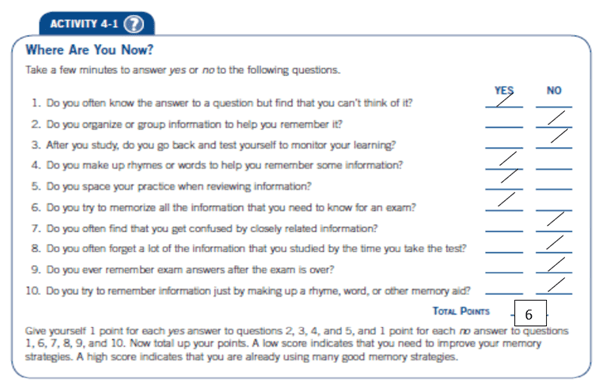
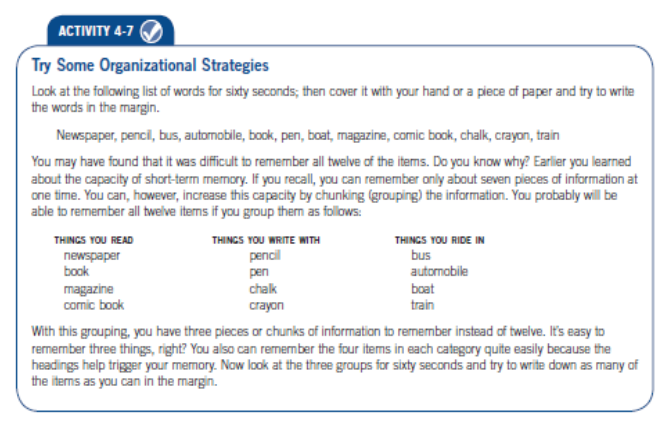
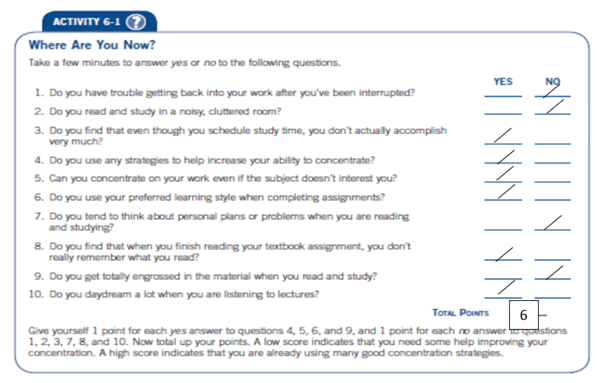
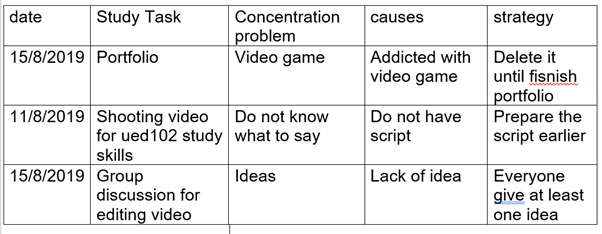
Figure 6.4
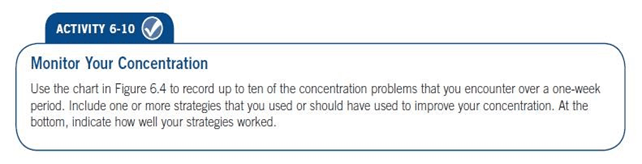
Monitor your Concentration chart
 Faiz CHU's blog